Showing posts with label Asia. Show all posts

Sunday, November 22, 2015

Bangladesh: A Golden Age

 
A Golden Age
by Tahmima Anam


A Golden Age, by Tahmima Anam, was featured on NPR, a source I trust absolutely for book recommendations.  But the main reason I chose it for Bangladesh is because my friend Liz told me it was one of her all-time favorites.  I really do want suggestions and really will consider them seriously. A Golden Age was right up my alley, so Liz either knows me well or it was a happy coincidence.  I've already mentioned my fondness for first novels, and this is an example of another homerun for a debut piece of fiction.  I also happen to have a special fondness for books set in South Asia.  I don't know why.  I've traveled a lot but not much in that part of the world other than a quick work trip to New Delhi, India where I didn't see much outside of the hotel and a few government offices where my meetings took place.  Something about those countries' cultures seem rich, vibrant, and enduring, and the setting is ripe for exploring themes that I get absorbed in when reading.  This book fit that description precisely and sparked my imagination through its story of a family that is shocked out of its every day normalcy and thrust into a time of war.
 
Rehana is a young woman when she is widowed by her husband's sudden death, too soon after their arranged marriage that generated deep love and two cherished children, Sohail and Maya.  The novel opens with Rehana's loss of custody because she is too poor to provide for them and moves quickly to her determined reversal of fortune when she improves her circumstances and recovers her babies in only a year's time.  From that point on, Rehana devotes herself to them, never contemplating herself or her future as she steers them towards adulthood and independence.  Just as they are on the brink of coming into their own, the country breaks into a civil war that no one saw coming. 
 
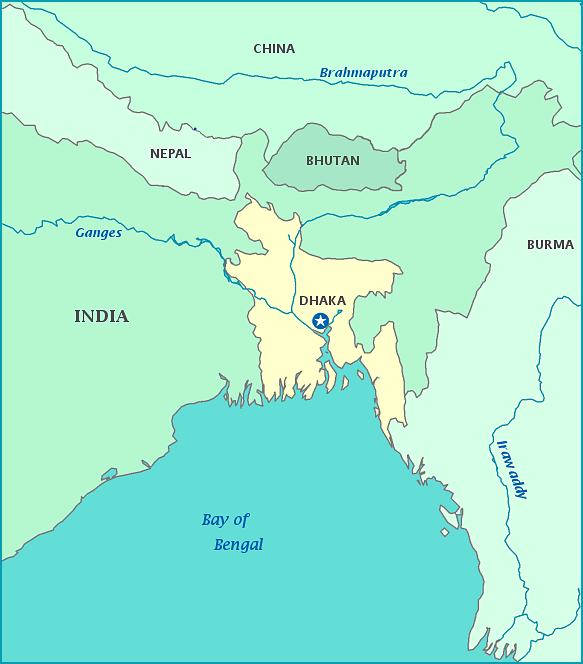
The war that provides the backdrop for the novel took place in 1971, when relations between East and West Pakistan, separated by the enormous country of India, became increasingly hostile.  Sohail and Maya, now young adults, are active on their college campus in protesting West Pakistan's refusal to recognize East Pakistan's elected leaders.  Tensions build quickly, and when the Pakistani army begins killing protesters, Sohail and Maya are pulled into a nationalistic fight for East Pakistan's independence.  Rehana is not especially political but has remained as devoted to her children as she vowed to be when they returned home so many years ago.  She, too, becomes pulled in, first by agreeing to house the resistance fighters, and then, just as the nation of Bangladesh is born, by falling in love with one of them.  As a reader, I also felt pulled ... into the history of Bangladesh, the fierce devotion of Rehana's motherhood, Sohail's determination, Maya's frantic search for her role, and ultimately, the awful choice Rehana is forced to make in the end.
 
There are parts of this novel where you'll find yourself drifting along with Anam's dreamy narrative and others where you'll be holding your breath with anticipation of what happens next.  This is one I'd strongly recommend to anyone!


Sunday, November 2, 2014

In the River Sweet


In the River Sweet, by Patricia Henley


This book is not part of the official challenge to read my way around the world.  In keeping with Rule #4, I picked this book off my shelf to read while, per the Albania Lesson Learned, I am waiting for the right Algeria book to come my way.  Years ago, I read Patricia Henley's novel, Hummingbird House, which was a National Book Award finalist and has a good rating of 3.7 stars on Goodreads.  I remember that I didn't particularly enjoy Hummingbird House, and had I recognized that In the River Sweet was by the same author, I probably wouldn't have bought it.  But the description on the book jacket intrigued me, so last Sunday while my husband Tim watched football, I curled up on the couch with a glass of wine and dove in.

And I really loved this story.

In the River Sweet takes place in present day, small town Indiana but swings back into the time of 30 years prior and the place of Saigon, Vietnam, during what the Vietnamese call the American War.  The novel is essentially about memory and loss and the ways in which the choices we make as individuals can generate pain for those we love, despite our best efforts to avoid doing exactly that. 

Johnny and Ruth Anne have been married a long time and are still deeply in love.  The novel begins as they are settled in middle age, happy with their quiet life in the Midwest, with Johnny running a restaurant and Ruth Anne working at the library.  Their daughter, Laurel, is a young adult, full of youth's vigor and promise, and just in love for the first time, with a woman she met at her father's cafĂ©.  Laurel's sexuality shocks and worries Ruth Anne, whose devout Catholicism challenges her to be accepting.  In addition, it stirs up deeply buried memories of a time in her own life when she made decisions not in keeping with the Church's doctrine.  While the family is adjusting, Ruth Anne is dealing with her cantankerous and often cruel aunt, who raised her and who is now dying.  Ruth Anne must also confront her feelings about forgiveness.  It is a confusing time, made bearable only by the steadfastness of her relationship with Johnny.  As she grapples with the conflict between what the Church has taught her to believe and what she actually feels, she confronts her past in a way that compromises the security of all she has built with Johnny over the years.

There's a lot in the novel that I can't talk about in a review for fear of spoiling it for other readers.  You'll have to pick it up yourself to find out what happens in small town Indiana when two young women fall in love, why Ruth Anne leaves her infant son behind when she returns from war-torn Vietnam, and what happens when she finally tells Johnny after 30 years of silence. 

Instead of focusing on plot, I'd like to take a moment to comment on Henley's style, specifically that she is minimalistic with her details and she doesn't use quotation marks.  I've never liked reading books without quotation marks and usually avoid them, even Cormac McCarthy's well-loved and highly regarded novels.  I find it distracting to be unsure of who is speaking or where a verbal comment is distinct from an unspoken thought.  But now, with this book, I find that I appreciate the mood it creates for me while reading.  This time, I didn't try to pin down the narrative and instead, let it wash over me while I focused on absorbing the images and meanings the words evoked. 

I found it to be rather like listening to a song on the radio, where you might not discern clearly all of the lyrics but it doesn't matter because the impact of the song comes from more than just the words.  There's the music, as a whole and from each individual instrument, differing between the verse and the refrain, perhaps featuring an instrumental solo, a soul-searing moment of harmony, or a bridge played in the minor key.  And of course, with music there is also the listener's own story.  What we bring to our experience of a song informs how we feel as we listen and what we think about the music.  The same can be said of books.  What I bring to the table as I open to the first page will certainly inform what I take away as I close the book at the last page.  In grad school, I studied this as reader response theory.  In my current life, I recognize this as simply one of the beautiful things about literature ... or any other form of art, for that matter.

My little girl, who is now 16 years old, was born in Vietnam.  When she was just shy of six months old, Tim and I departed from Dulles airport on New Year's Eve ... our first time out of the country ... and flew halfway around the world.  More than 24 hours later, we landed in Saigon, where we then got on another plane to Nha Trang, and then rode in a van along a bumpy coastal highway to a tiny orphanage in Tuy Hoa.  Everything about Vietnam was so different from anything I'd seen before, we may as well have been on another planet.  Four days after getting on that first airplane, we met our daughter for the first time, and a month after that, we brought her home.

Our lives were completely changed in a number of ways by adopting our amazing Grace and through our experience of her beautiful birth country.  I undoubtedly left a piece of my heart there and am drawn to any story that helps me to learn more about Vietnam.  This one, for me, was magical.